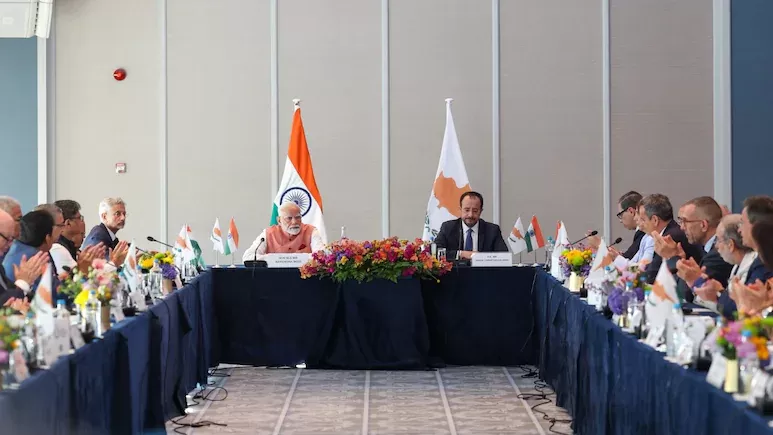
Prime Minister Narendra Modi, addressing the India-Cyprus CEO Forum in Limassol, underscored India’s meteoric economic rise and ambitious trajectory towards becoming the world’s third-largest economy. Highlighting policy reforms, digital innovation, and robust economic indicators, Modi projected India as a beacon of global opportunity. He emphasized the success of structural changes like GST and corporate tax reform, praised India’s digital payment dominance via UPI, and extended an invitation for Cyprus to integrate into India’s digital economy. Modi’s remarks—delivered during the first prime ministerial visit to Cyprus in two decades—positioned India as a global partner for economic collaboration, infrastructure development, and manufacturing leadership.
Reimagining India’s Global Economic Identity
During his address at the India-Cyprus CEO Forum in Limassol, Prime Minister Narendra Modi laid out a compelling vision for India’s economic trajectory. Emphasizing India’s evolution into the world’s fifth-largest economy, Modi predicted a swift advance toward becoming the third-largest global economy. His comments came during a historic visit—India’s first prime ministerial trip to Cyprus in over 20 years—underscoring the strategic importance New Delhi places on fostering deeper business and geopolitical ties with the European Union via Cyprus.
Modi’s keynote framed India as not just a large economy, but a dynamic one—built on clarity of policy, ease of doing business, and tech-enabled transformation. The very first event of his visit was a business forum, a symbolic gesture that reinforced India’s desire to strengthen commercial partnerships across borders.
Structural Reforms That Reshaped the Indian Economy
At the core of Modi’s address was a detailed recounting of India's economic reforms over the past decade. He spotlighted the implementation of the Goods and Services Tax (GST), which unified the country under a “one nation, one tax” framework, as a landmark reform. In tandem, the reduction in corporate tax rates and the decriminalization of outdated economic laws have, he argued, not only simplified the regulatory environment but also bolstered investor confidence.
“These reforms reflect more than just economic policy—they reflect our governance philosophy,” Modi stated, noting that India now operates with both clarity and stability in policymaking, two critical factors that global investors look for in emerging markets.
UPI and the Digital Revolution: India’s Soft Power Export
Among the most notable accomplishments highlighted was India’s digital transformation. Modi emphasized that over 50 percent of the world’s digital transactions now occur through India’s Unified Payments Interface (UPI)—a fact that has positioned the country as a global leader in financial innovation.
He credited this transformation to an unprecedented wave of digital public infrastructure and widespread financial inclusion. “This is not just about convenience; this is about empowering people,” Modi asserted.
India has already extended UPI partnerships to countries like France, and Modi announced ongoing discussions with Cyprus to enable similar collaboration. Such digital diplomacy, he argued, represents a powerful tool for fostering mutual growth and innovation between nations.
Building the India of the Future: Infrastructure, Manufacturing, and Aviation
Looking ahead, Modi pointed to key focus areas that will shape India’s next phase of growth. The recently launched Manufacturing Mission is designed to accelerate production capabilities in high-value sectors such as electronics, semiconductors, information technology, biotechnology, and green technology.
Simultaneously, the Indian government is making significant investments in maritime infrastructure, including port development and shipbuilding, as well as in the expansion of its civil aviation sector—recognizing these as foundational pillars of a globally integrated economy.
“These sectors are not just about economic metrics. They are about future readiness. They’re about placing India at the center of global value chains,” Modi said, articulating a vision that intertwines national growth with global relevance.
Strengthening Bilateral Ties Through Shared Economic Aspirations
Modi acknowledged that while current bilateral trade between India and Cyprus stands at approximately USD 150 million (roughly Rs. 1,250 crore), the latent potential is significantly greater. Many Indian firms already view Cyprus as a gateway to European markets—a sentiment Modi encouraged as he called for deeper collaboration in trade, investment, and digital infrastructure.
His message was clear: India, with its massive consumer base, reformed economy, and commitment to innovation, stands ready to partner with like-minded nations for mutual prosperity.
Conclusion: A Vision of Confidence and Global Ambition
Prime Minister Modi’s address to the India-Cyprus CEO Forum was more than a ceremonial speech—it was a declaration of intent. With data-backed optimism and a clear roadmap, he invited global stakeholders to partake in India’s journey toward becoming an economic superpower.
By combining structural reforms, digital leadership, and strategic international outreach, India is no longer merely participating in the global economy—it is actively shaping it.
Comments