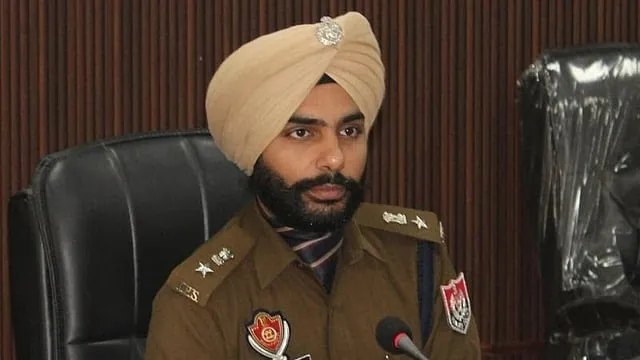
The Punjab government has suspended Senior Superintendent of Police (SSP) Maninder Singh of Amritsar Rural, citing “dereliction of duty” in addressing the rising tide of organized crime. Intelligence reports and internal reviews pointed to delays in investigation and insufficient ground-level action against gangsters. Maninder Singh, a 2019-batch IPS officer, has previously served in key postings, including as ACP in Amritsar City and SP in Tarn Taran. The decision comes as Chief Minister Bhagwant Mann signals a zero-tolerance approach to criminal networks, signaling a tighter clampdown on law-and-order failures.
A Harsh Reprimand by the State
In a decisive move, Punjab’s Aam Aadmi Party (AAP)-led administration has suspended SSP Maninder Singh from his role in Amritsar Rural, following serious allegations of negligence in tackling organized crime. Government sources suggest the suspension stems from a confluence of intelligence warnings and internal reports that underscored a weak police response to escalating gangster activity.
The action — ordered directly by Chief Minister Bhagwant Mann — underscores the government’s determination to hold law-enforcement accountable for perceived lapses in protecting public safety. Officials cited “delays in investigations” across several major cases as the basis for disciplinary action.
The Charges: Inaction at Multiple Levels
According to the state administration, Maninder Singh failed to exercise sufficient vigilance against crime syndicates operating in his jurisdiction. Investigations reportedly revealed that several high-priority cases related to organized criminals languished without timely progress. Some intelligence inputs pointed to operational complacency and a lack of proactive police initiatives.
This alleged inertia not only reflected poorly on the district’s crime-fighting capacity but also raised questions about the effectiveness of senior leadership in responding to grassroots threats. Sources indicate repeated warnings had been raised, but consistent action was lacking.
Profile of the Suspended Officer
Maninder Singh, who joined the Indian Police Service in 2019, has had a diverse and rapid rise through the ranks. He previously held the position of Assistant Commissioner of Police in the Amritsar City Commissionerate and had also served as Superintendent of Police in the Tarn Taran district. His tenure included a stint as ADC (Aide-de-Camp) to the Governor of Punjab, a role that typically indicates high trust and responsibility.
Despite these credentials, the government’s recent move suggests that his early promise has been overshadowed by criticism over failure to crack down on organized crime.
Political Stakes and Law-and-Order Narrative
Chief Minister Mann has repeatedly vowed that his administration would not tolerate gangsterism or mafioso networks, promising strong action against criminal elements deeply embedded in Punjab’s social fabric. The suspension comes at a politically sensitive time as the government seeks to project a tough-on-crime image.
Opposition parties, meanwhile, have seized on the development, framing it both as vindication for long-standing critiques of police inefficiency and as a cautionary tale about the challenges facing the AAP government in maintaining internal accountability.
Strategic and Social Implications
From a governance standpoint, this suspension signals a renewed push to professionalize policing and enforce stricter accountability at senior levels. It sends a clear message that negligent leadership will have direct consequences, potentially reshaping how crime priority-setting is handled across the state.
Socially, the move could boost public confidence in the government’s willingness to face tough security challenges. However, it also raises the stakes for law-enforcement agencies to deliver measurable results — simply ousting an officer may not be enough unless replaced with effective, crime-fighting leadership.
Looking Forward: Accountability and Reform
The suspension of Maninder Singh could be a precursor to wider reforms within Punjab’s police force. If followed by comprehensive disciplinary action, systemic changes, and strengthened intelligence-driven policing, it may mark the beginning of a sharper crackdown on criminal networks.
Yet, the key question remains: will this be a symbolic gesture, or the start of a deeper institutional overhaul? For the AAP government, the test will be demonstrating sustained improvements in public safety, not just holding one officer to account.
Comments