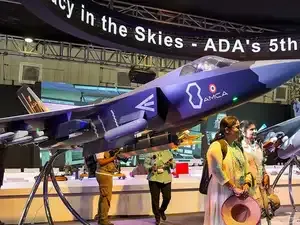
Larsen & Toubro (L&T) and Bharat Electronics Limited (BEL) have announced a landmark partnership to collaborate on India’s ambitious Advanced Medium Combat Aircraft (AMCA) project, a next-generation stealth fighter jet program designed to strengthen the country’s defense autonomy. This alliance will leverage L&T’s expertise in aerospace manufacturing and BEL’s capabilities in defense electronics to develop an indigenous fifth-generation multirole fighter. The partnership aligns with India’s Atmanirbhar Bharat initiative, aiming to reduce dependency on foreign suppliers and position the nation as a global player in advanced military aviation technology while bolstering domestic industrial and technological capacity.
India’s Leap Toward Air Superiority
India’s AMCA program represents a strategic effort to develop a homegrown stealth fighter jet capable of competing with cutting-edge aircraft operated by global powers. Managed by the Aeronautical Development Agency (ADA) under the Ministry of Defence, the project aims to provide the Indian Air Force (IAF) with a sophisticated multirole platform that integrates stealth design, supercruise capability, advanced avionics, and network-centric warfare features.
With tensions in Asia and evolving global security challenges, self-reliance in aerospace technology has become a national imperative. The AMCA program is expected to significantly reduce reliance on imports, fostering a resilient domestic ecosystem for defense manufacturing and innovation.
L&T and BEL: A Strategic Collaboration
The newly formed alliance between L&T, a leader in complex engineering and systems integration, and BEL, India’s premier defense electronics manufacturer, is a crucial step in the AMCA’s development.
L&T will focus on manufacturing airframes, integrating propulsion systems, and delivering precision-engineered structural components, while BEL will take charge of mission-critical electronics, such as radars, electronic warfare suites, avionics, and secure communication systems.
Both companies have a proven track record, having collaborated on the Light Combat Aircraft (LCA) Tejas program, where they delivered key structural and electronic components. This shared experience is expected to streamline development timelines and ensure world-class quality standards for the AMCA.
The Confidential EoI and Project Timeline
The Aeronautical Development Agency recently issued an Expression of Interest (EoI), inviting bids from leading defense firms for the AMCA program. L&T and BEL are preparing a joint response, expected to be submitted in the coming weeks.
The project is currently in its advanced design phase, with prototype rollout targeted for 2027. Initial production could begin in the early 2030s, contingent on successful testing and regulatory certification. This timeline reflects the complexity of developing fifth-generation fighter technology, which requires integrating cutting-edge stealth materials, avionics, and propulsion systems.
Technological Significance
The AMCA will represent a leap forward in India’s indigenous military technology capabilities, incorporating features comparable to global fifth-generation fighters such as the F-35 Lightning II and Sukhoi Su-57. Key design highlights include:
- Stealth Capabilities: Radar-absorbing materials and low-observable airframe design to reduce detectability.
- Supercruise Performance: Sustained supersonic flight without afterburners for enhanced efficiency and combat advantage.
- Integrated Avionics Suite: Advanced radar systems, secure communication links, and AI-driven battle management tools.
- Sensor Fusion Technology: Real-time data integration to improve situational awareness and decision-making.
- Multirole Flexibility: Ability to perform air superiority, ground attack, reconnaissance, and electronic warfare missions.
Challenges and Strategic Risks
While the collaboration is a promising milestone, several challenges could affect the program’s trajectory:
Complex Technology Integration – Developing a stealth fighter requires cutting-edge materials, precision manufacturing, and advanced propulsion technologies that demand sustained R&D investments.
Regulatory and Certification Hurdles – Meeting stringent testing and certification standards will be time-intensive, with potential delays impacting production timelines.
Cost Overruns – Fifth-generation fighters are notoriously expensive, and budgetary discipline will be critical to avoid escalating costs.
Supply Chain Dependence – Sourcing specialized components domestically remains a challenge, and reliance on imports for critical systems could hinder the project’s self-reliance goals.
Global Geopolitical Dynamics – Shifts in international relations could impact technology transfers, collaborations, and export potential.
Economic and Industrial Impact
Beyond its military significance, the AMCA program will stimulate India’s defense industrial base and create thousands of high-skilled jobs. It is expected to catalyze advancements in material science, aeronautical engineering, electronics, and artificial intelligence, fostering innovation across industries.
The project aligns with the government’s Make in India and Atmanirbhar Bharat initiatives by positioning India not just as a defense equipment consumer but as a leading developer of advanced aerospace technologies. Successful execution could also open export opportunities to friendly nations seeking cost-effective, modern fighter aircraft.
A Transformative Moment for Indian Defense
The partnership between L&T and BEL represents a pivotal step in India’s journey toward defense self-sufficiency. By combining the private sector’s engineering agility with state-owned BEL’s technological depth, the collaboration promises to deliver a sophisticated, homegrown fighter jet that enhances national security and industrial resilience.
If executed effectively, the AMCA could elevate India to the elite group of nations capable of designing and producing fifth-generation fighters, marking a defining moment for both the Indian Air Force and the country’s strategic future.
Comments