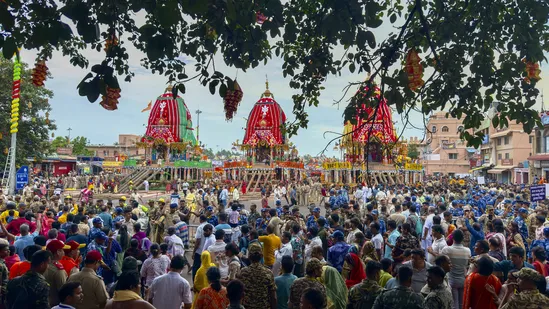
In the early hours of Sunday, a devastating stampede near the Gundicha Temple in Puri, Odisha, claimed three lives and injured fifty others during the annual Rath Yatra festival. State officials moved swiftly to manage the aftermath, with the law minister announcing a 30-day administrative investigation led by Development Commissioner Anu Garg. The incident, attributed to overcrowding and poor crowd management, has triggered both public mourning and government action. Chief Minister Mohan Charan Majhi expressed condolences and took decisive measures, including suspending senior police officials. As Odisha grapples with the tragedy, questions around event safety and administrative preparedness loom large.
A Sacred Celebration Turns Fatal
What began as a spiritually charged night for thousands of devotees awaiting the unveiling of the deities at the famed Rath Yatra in Puri, turned into a harrowing tragedy. At approximately 1 a.m. on Sunday, a sudden surge in the crowd led to a stampede near the Gundicha Temple. The pressure of the mass gathering, intensified by devotees’ eagerness to catch a glimpse of Lord Jagannath, Lord Balabhadra, and Devi Subhadra, proved fatal for three individuals: Basanti Sahu (36) from Bolagarh, Premakant Mohanty, and Pravati Das from Balipatna in Bhubaneswar.
While stampedes at large religious congregations are not unprecedented in India, the Puri incident has reignited long-standing concerns about the adequacy of crowd control measures during major festivals.
Swift Political Response and Official Apology
Odisha's Chief Minister Mohan Charan Majhi publicly acknowledged the administration’s failure to manage the crowd. In a statement posted on social media, he attributed the incident to "jostling and chaos" caused by an overwhelming surge of devotees near Sharadhabali. Demonstrating political accountability, Majhi issued an apology on behalf of the state and promised corrective measures.
Two senior officials—Puri Deputy Commissioner of Police Bishnu Charan Pati and Police Commandant Ajay Padhi—were suspended on Sunday following the incident. The move was widely interpreted as a direct response to administrative lapses that may have contributed to the tragedy.
Investigative Action and Public Reassurance
In a press briefing, Odisha’s Law Minister Prithiviraj Harichandan announced the commencement of an administrative probe led by Development Commissioner Anu Garg. The report is expected to be submitted to the Chief Minister within 30 days. Harichandan assured that those found negligent will face stringent action. “The state government will take stern action against those responsible for the tragic incident,” he told the media.
The law minister's comments were clearly aimed at reassuring the public and restoring confidence in the state’s commitment to safety and governance.
Medical Response and Recovery
Despite the initial chaos, the local health infrastructure managed to respond promptly. According to Dr. Kishore Satapathy, Chief District Medical Officer (CDMO) of Puri, all 50 injured individuals were treated and discharged by 8 p.m. on the same day. “All the injured have been discharged from the hospital after their health condition was assessed. All are now stable,” he confirmed.
The timely medical intervention likely prevented the fatality count from rising, underscoring the critical role of emergency preparedness in large-scale public events.
Broader Implications for Event Management
While the Rath Yatra remains one of the most revered religious events in India, drawing millions annually, this tragedy lays bare the inadequacies in planning and real-time management. Despite previous crowd-control experiences, lapses continue to occur. Experts argue for the adoption of modern crowd simulation tools, greater use of drone surveillance, and more rigorous training for ground personnel.
There is also growing advocacy for appointing independent safety auditors for large-scale events, especially those involving high-density public gatherings. The integration of technology with traditional management strategies may provide a much-needed layer of safety.
A Call for Institutional Reform
The stampede has triggered a wider debate about institutional preparedness and the cost of administrative complacency. Although the Chief Minister’s apology and swift action were notable, critics argue that proactive planning—not reactive accountability—should be the new standard. The coming weeks will be crucial as the inquiry progresses and the government decides on reform measures based on its findings.
If Odisha is to retain public trust and avoid future tragedies, it must treat this incident not merely as an aberration but as a call to overhaul its crowd management and disaster preparedness frameworks.
Final Thoughts
The Puri stampede is a somber reminder that even the most sacred of occasions are not immune to tragedy when public safety takes a backseat. As Odisha confronts the emotional and political fallout of the incident, its response could set a precedent for how India handles mass religious events in the future. The government’s promise of justice and reform must translate into sustained action—only then can the spirit of devotion be safely preserved for generations to come.
Comments