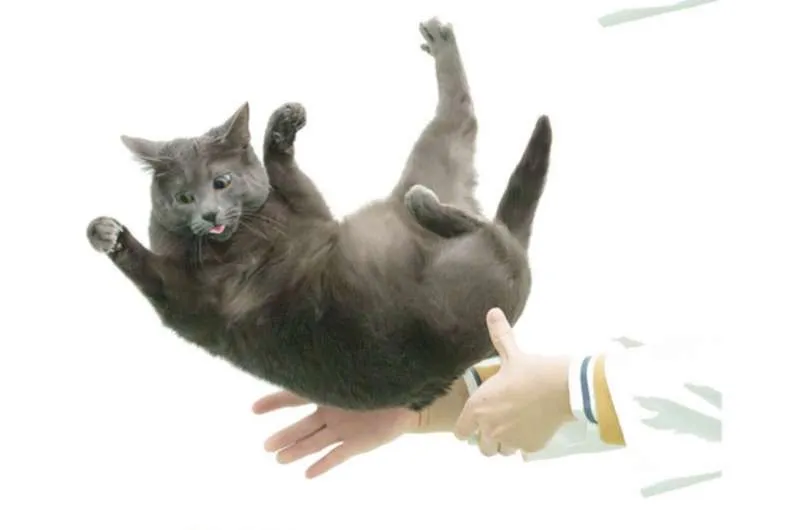
Scientists have long been fascinated by the remarkable ability of cats to land on their feet after a fall. Recent research continues to highlight the unique combination of anatomy, reflexes, and physics that allows felines to reorient their bodies midair. Known as the “righting reflex,” this phenomenon enables cats to twist their bodies rapidly and stabilize their landing position even when dropped from unexpected angles. Researchers say the mechanism involves flexible spines, highly responsive vestibular systems, and precise muscle coordination. Understanding this natural adaptation not only sheds light on animal biomechanics but also inspires innovations in robotics and motion-control technology.
The Science Behind the “Righting Reflex”
Cat possess a unique biological ability known as the righting reflex, which allows them to reorient their bodies during a fall and land on their feet.
This reflex typically begins within milliseconds after a cat senses that it is falling. Using visual cues and its inner ear balance system, the animal rapidly determines its orientation in space. The head rotates first, followed by the spine and the rest of the body, allowing the cat to align its feet downward before landing.
Scientists say this highly coordinated movement occurs so quickly that it often appears almost effortless to observers.
Anatomy That Enables Midair Rotation
A key factor in a cat’s ability to perform this maneuver is its extremely flexible spine. Unlike many other mammals, cats have a skeletal structure that allows significant rotational movement between vertebrae.
Their bodies are also relatively lightweight with a low moment of inertia, making it easier for them to twist and rotate while falling. By arching their backs and adjusting the position of their limbs, cats can effectively manipulate their body orientation without relying on external surfaces.
This flexibility allows them to complete the reorientation process even during short falls.
The Role of Physics in Cat Landings
From a physics perspective, the cat’s midair adjustment demonstrates the principle of conservation of angular momentum. Even without pushing against a surface, the animal can redistribute its body mass to rotate different parts of its body independently.
By pulling in its front legs while extending its rear legs—or vice versa—a cat can alter its rotational speed in different segments of its body. This complex movement allows the animal to twist and align itself vertically before reaching the ground.
Researchers often cite the cat righting reflex as a classic example in biomechanics and physics studies.
Evolutionary Advantages for Survival
The righting reflex likely evolved as a survival mechanism. Cats are natural climbers and frequently navigate elevated environments such as trees, walls, and rooftops.
Being able to land safely after a fall would have provided a significant evolutionary advantage, reducing the risk of injury while hunting or escaping predators. Additionally, cats often spread their legs during descent, increasing air resistance and slowing their fall.
This behavior helps cushion the impact and improve the chances of landing safely.
Applications Beyond Animal Biology
The scientific understanding of feline biomechanics has extended beyond the field of zoology. Engineers and robotics researchers study the righting reflex to design machines capable of stabilizing themselves during falls.
For example, autonomous robots and drones may use similar principles to regain balance or adjust orientation in midair. Motion-control algorithms inspired by animal reflexes are also being explored in aerospace engineering and advanced robotics systems.
Such interdisciplinary research demonstrates how insights from biology can influence technological innovation.
Continuing Curiosity in Scientific Research
Although the phenomenon has been studied for decades, scientists continue to explore new aspects of feline movement and balance. Advanced imaging technologies and motion analysis tools now allow researchers to examine these rapid movements in greater detail.
Understanding the mechanics of animal motion not only enriches biological knowledge but also provides inspiration for solving complex engineering challenges.
For many researchers, the humble cat remains a remarkable example of how nature combines anatomy, physics, and instinct to achieve extraordinary results.
Comments