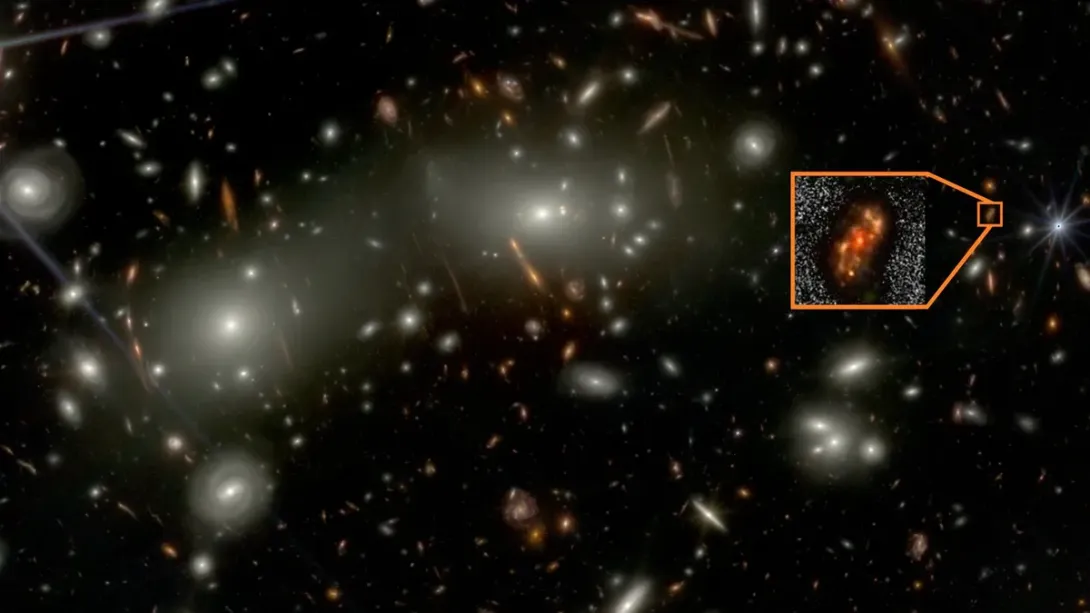
In a groundbreaking discovery, Indian astronomers have identified an ancient spiral galaxy, now named ‘Alaknanda’, located billions of light-years from Earth. The galaxy’s unique structure and composition provide critical insights into early cosmic evolution, shedding light on star formation, galactic morphology, and interstellar dynamics in the young universe. Using advanced telescopes and spectroscopic analysis, scientists have mapped its spiral arms, estimated its stellar population, and traced its chemical makeup. This discovery marks a significant milestone in Indian astrophysics, contributing to the global understanding of galaxy formation and evolution while demonstrating the country’s growing capabilities in cutting-edge astronomical research.
Discovery and Observation
- Location and Distance: ‘Alaknanda’ is situated over 10 billion light-years away, placing it in the early epoch of the universe.
- Detection Methodology: Utilizing radio telescopes and deep-sky imaging, astronomers detected the spiral structure and analyzed light signatures to determine its composition and age.
- Team and Collaboration: Led by scientists from Indian Institute of Astrophysics and in collaboration with international observatories, the project combined multi-wavelength data and computational modeling.
Significance of the Discovery
Early Universe Insights: Provides a rare glimpse into the formation of spiral galaxies shortly after the Big Bang.
Stellar Composition Analysis: Spectroscopic studies reveal elemental abundances that inform models of star formation and chemical evolution.
Galactic Dynamics: Mapping spiral arms aids in understanding rotational dynamics and mass distribution, offering clues about dark matter in early galaxies.
Technological Achievement: Highlights India’s growing capabilities in deep-space observation and computational astrophysics.
Implications for Astronomy
- Theoretical Models: Data from Alaknanda will refine galaxy formation simulations, providing benchmarks for cosmic evolution theories.
- Future Observations: The galaxy will serve as a target for next-generation telescopes, including the James Webb Space Telescope, enabling more detailed infrared studies.
- Global Recognition: Positions India as a key contributor to contemporary astrophysical research, fostering international collaborations.
Expert Commentary
- Dr. Meera Raghavan, lead astrophysicist, noted: “Discovering Alaknanda offers an extraordinary window into our cosmic past, revealing the mechanisms that shaped galaxies billions of years ago.”
- Implications for Education and Research: The find is expected to inspire young Indian scientists and stimulate investment in astronomical infrastructure and research initiatives.
The discovery of Alaknanda not only enriches our understanding of the early universe but also cements India’s role in global astrophysical research. As astronomers continue to study its structure and composition, this ancient galaxy promises to unlock new frontiers in our comprehension of cosmic history, marking a pivotal moment in space science.
Comments