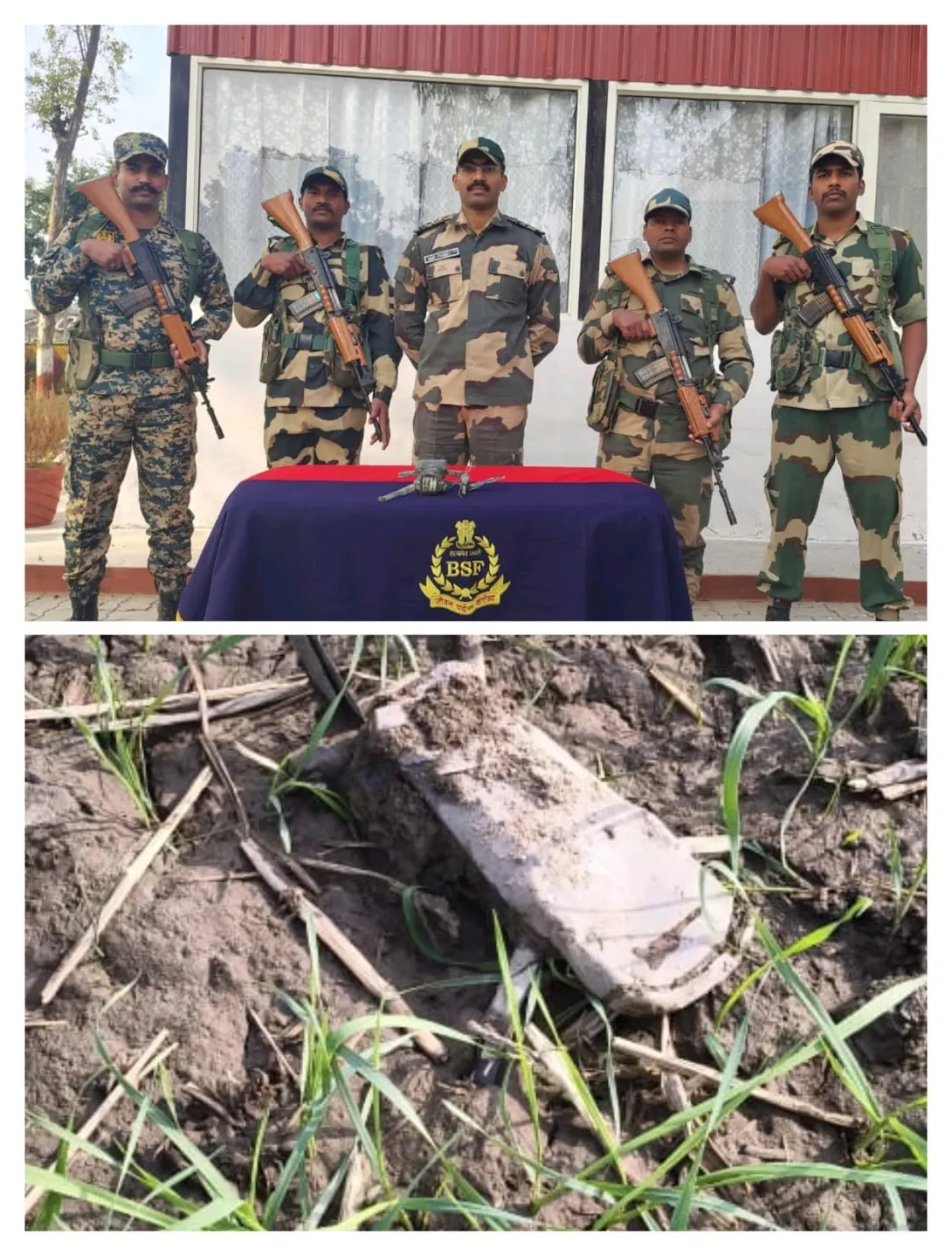
In a late-night counter-smuggling operation, the Border Security Force (BSF) neutralised three drones hovering over the Punjab–Pakistan border, underscoring its intensified efforts to curb aerial contraband routes. The operation, based on precise intelligence, saw technical countermeasures deployed to down and recover the unmanned aerial vehicles in separate incidents across Ferozepur and Tarn Taran districts. The recovered drones—a mix of smaller and larger models—are suspected of being used for narcotics smuggling from across the border. The development highlights the evolving nature of cross-border crime and the BSF’s tactical sophistication.
Strategic Anti-Smuggling Response by BSF
According to a BSF press release, alert troops acted swiftly after detecting suspicious aerial objects in the border sector. In Tarn Taran’s Wan village, they recovered a DJI Mavic 3 Classic drone following a targeted search operation.
In a separate incident along the Ferozepur sector, BSF personnel activated technical countermeasures to intercept two additional drones. Subsequent field searches led to the recovery of a DJI Matrice 400 and a DJI Matrice 350 in agricultural fields in Bhangala village.
Implications for Cross-Border Security
These latest recoveries reflect the increasing sophistication of smuggling networks employing aerial technology. The use of large drones like the Matrice series suggests a shift from ad-hoc contraband drops to more organized and higher-capacity operations. For the BSF, neutralising such threats is not just about intercepting drones—it involves dismantling supply chains, tracking the source of the missions, and building a more robust intelligence network.
Operational Capabilities and Technological Edge
The success of the operation is a testament to the BSF’s enhanced technological readiness. By deploying real-time technical countermeasures and using precise search protocols, the force demonstrated both agility and preparedness—a combination crucial for dealing with modern smuggling tactics.
These operations are consistent with BSF’s broader mandate in Punjab, where recent years have seen multiple drone interdictions and significant contraband recoveries.
Challenges Ahead and Policy Considerations
While drone recoveries represent tactical wins, they also underscore a growing challenge in border management: the escalation of low-cost, high-impact aerial smuggling. Policymakers may need to explore expanded investment in anti-drone systems, shared intelligence frameworks, and cross-border cooperation to neutralise the root of such operations. Equally critical is building capacity at the district level so that insertions and recoveries can be managed promptly without jeopardizing security.
The Bigger Picture: Border Security and National Vigilance
This operation highlights the dynamic character of modern cross-border crime. As smuggling networks adopt UAVs to bypass traditional patrols, the onus is on security agencies to remain equally adaptive. For the BSF, these three drones are more than intercepted objects — they are indicators of changing operational paradigms that demand strategic long-term responses.
Comments