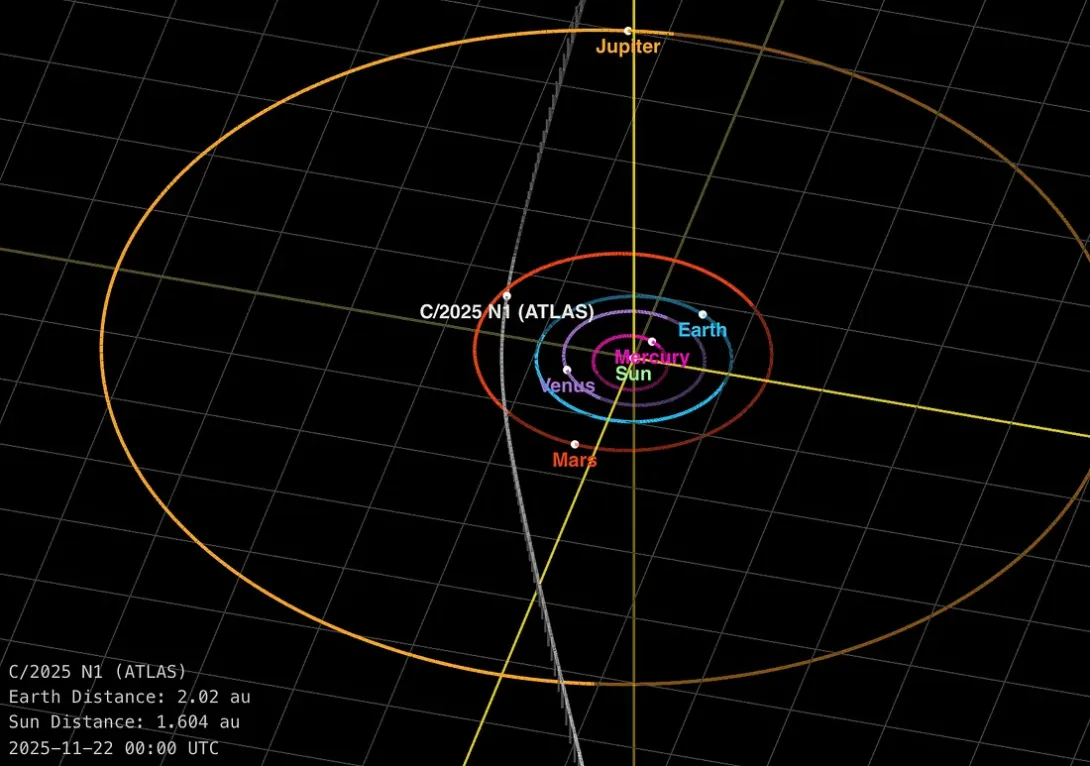
NASA has released unprecedented images of the interstellar comet 3I/ATLAS, offering scientists and the public a rare glimpse into a celestial visitor from beyond our solar system. The comet, first detected in late 2020, exhibits unique characteristics that distinguish it from typical solar system comets, including an unusual trajectory and composition. High-resolution imagery captured by space-based telescopes provides critical data for understanding its structure, outgassing activity, and interaction with solar radiation. These observations not only deepen knowledge of cometary science but also enhance understanding of the broader dynamics of interstellar objects traversing the Milky Way.
Discovery and Trajectory
3I/ATLAS was initially observed by the Asteroid Terrestrial-impact Last Alert System (ATLAS) and quickly classified as interstellar due to its hyperbolic orbit, indicating it originated outside our solar system. NASA’s imaging campaign focused on tracking its trajectory and composition, confirming that it is unlike comets originating within the solar system. This offers a rare opportunity to study materials formed in other star systems.
Scientific Insights from Imaging
The images reveal a pronounced cometary tail and active outgassing, suggesting the presence of volatile ices that sublimate when exposed to sunlight. Scientists note variations in brightness and coma structure, which may provide insights into the comet’s rotational dynamics and internal composition. These observations are critical for comparative studies between interstellar and solar system comets.
Technological Advances Enabling Observation
High-resolution imaging was achieved through a combination of space telescopes and ground-based observatories equipped with advanced spectrographic instruments. These technological advancements allow for precise measurement of the comet’s composition, speed, and trajectory, enhancing predictive models for future interstellar objects.
Implications for Interstellar Research
The study of 3I/ATLAS has broad implications for astrophysics and planetary science. By analyzing its composition and behavior, scientists can infer the chemical diversity of distant planetary systems, potentially informing models of planetary formation and the prevalence of organic compounds across the galaxy.
Public Engagement and Educational Value
NASA’s release of these images also serves an educational purpose, inspiring public interest in space exploration and the study of interstellar phenomena. The visual data allows enthusiasts and researchers alike to engage with cutting-edge discoveries in real time.
Conclusion
The release of images of interstellar comet 3I/ATLAS represents a milestone in the study of objects from beyond our solar system. Combining advanced imaging technology with meticulous scientific analysis, NASA provides a window into the dynamics and composition of distant celestial visitors, enriching both scientific understanding and public fascination with the cosmos.
Comments