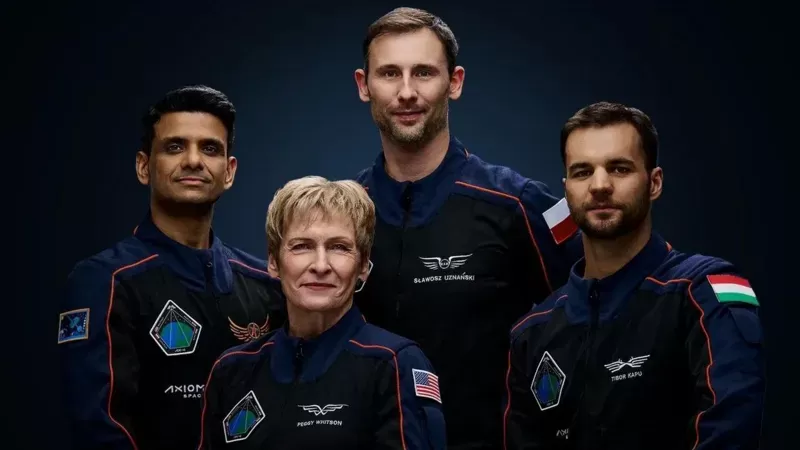
Indian astronaut Shubhanshu Shukla is set to embark on his historic maiden space journey aboard Axiom Space's fourth commercial mission to the International Space Station (ISS), slated for launch on June 10, 2025, from Florida's Kennedy Space Center. This mission marks a significant milestone for both India and Europe, as it includes the first-ever spaceflight for crew members from Poland and Hungary. As the pilot of the Axiom-4 mission, Shukla will conduct groundbreaking experiments in collaboration with ISRO, NASA, and the Department of Biotechnology (DBT), aiming to pave the way for future long-duration space exploration. Here's a deeper look into the mission's significance and the innovations it promises.
Shubhanshu Shukla: India’s First Citizen Astronaut to Reach the ISS
Shubhanshu Shukla, known by his nickname "Shuks," is set to make history as India’s first citizen astronaut to journey to the International Space Station (ISS). As part of Axiom Space’s fourth commercial mission, Axiom-4, Shukla's upcoming space flight on June 10, 2025, aboard SpaceX's Falcon-9 rocket from the Kennedy Space Center in Florida will be a milestone event for India and the global space community.
This mission holds a dual significance: not only does it represent India’s entry into the ranks of nations sending their citizens to space but it also marks a historic achievement for Europe, with the inclusion of crew members from Poland and Hungary. Both countries will make their maiden voyages to the ISS, reflecting the mission’s international collaboration.
Axiom-4 Mission: Crew and Mission Goals
Axiom-4 is a pioneering mission that will send a diverse crew to the ISS for a 14-day stay, focusing on science, outreach, and commercial activities. Leading the mission will be veteran U.S. astronaut Peggy Whitson, who will serve as the mission commander. Alongside Shukla, the crew will consist of Polish astronaut Slawosz Uznanski-Wisniewski and Hungarian astronaut Tibor Kapu, each representing their respective nations in a historic first journey to space.
During their stay, the astronauts will conduct approximately 60 scientific studies and activities, contributing to advancements in various scientific fields. The mission will span across 31 countries, further emphasizing the global nature of this landmark endeavor. The primary objective is to enhance our understanding of life in space, with a specific focus on future human space travel, as well as the development of sustainable life-support systems.
Shubhanshu Shukla’s Role: Conducting Groundbreaking Experiments
As the pilot of Axiom-4, Shukla will play a pivotal role in carrying out scientific experiments, particularly in the realm of space nutrition and agricultural growth in microgravity. In collaboration with the Indian Space Research Organisation (ISRO) and the Department of Biotechnology (DBT), Shukla will conduct experiments focused on pioneering self-sustaining life support systems for long-duration space missions.
One of the standout experiments involves the cultivation of Indian food crops in space. Shukla will work with seeds of methi (fenugreek) and moong (green gram), observing how they sprout and grow in microgravity conditions. These experiments aim to uncover crucial insights about food production in space, a vital aspect of long-term human space exploration. The research also aims to understand how these plants adapt to space conditions and how they can be cultivated over generations when returned to Earth.
A Historic Collaboration: ISRO, NASA, and the Department of Biotechnology
The collaboration between ISRO, NASA, and DBT in the Shukla-led experiments underscores the growing international cooperation in space science. ISRO’s involvement is particularly significant, as it marks the first time that an Indian astronaut will conduct experiments on the ISS in partnership with a space agency beyond India.
The partnership aims to expand the understanding of how food and nutrition can be sustained in space, which is essential for long-duration missions to the Moon, Mars, and beyond. This type of research will also help in developing closed-loop life-support systems—systems capable of recycling waste and producing food, oxygen, and water. These are critical for deep-space exploration, where traditional resupply missions are not feasible.
Shukla’s Vision: A Space Mission for 1.4 Billion Indians
Throughout the mission, Shukla intends to capture his experiences aboard the ISS through photos and videos, sharing them with his fellow countrymen back home. He sees this mission not just as a personal achievement, but as a collective journey for the 1.4 billion people of India. His goal is to give Indians a window into the world of space exploration, making the mission feel as if it is a shared experience for the entire nation.
In his own words, Shukla expressed his excitement by stating, “I want them to share this thrilling experience through my eyes, for I truly believe that, even as an individual travelling to space, this is the journey of 1.4 billion people.”
This sentiment reflects the deep emotional connection Shukla has to his mission. His approach highlights the rising importance of space exploration in India’s collective identity, as the nation increasingly looks to the stars for its future.
Scientific Impact: The Future of Space Research and Exploration
The Axiom-4 mission, especially with Shukla’s involvement, holds immense scientific promise. The experiments being carried out are part of a broader initiative to create sustainable, long-term systems for living and working in space. This is particularly important as space agencies look toward future missions, including those to the Moon and Mars, where self-sufficiency will be crucial for astronaut survival.
By focusing on space nutrition and agricultural research, the mission could pave the way for future astronauts to grow their own food, recycle resources, and live in isolated, confined environments for extended periods. In the long run, these experiments could have applications not only in space but also in addressing challenges related to food security and sustainability on Earth.
Conclusion: A Historic Moment for India and the Global Space Community
As Shubhanshu Shukla gears up for his spaceflight aboard Axiom-4, his journey symbolizes a new chapter for India in the realm of space exploration. With his participation, India joins an elite group of nations sending citizens to space, further solidifying its presence on the global stage.
More importantly, Shukla’s mission highlights the importance of international cooperation, scientific research, and the role that space exploration plays in advancing our knowledge of the universe. With significant contributions to space nutrition, sustainability, and space science, the Axiom-4 mission promises to be a landmark event in the history of human spaceflight.
For Shukla, the mission isn’t just about the thrill of space travel; it’s about inspiring an entire nation, making India’s ambitions in space more tangible for millions of citizens. As the countdown to June 10 begins, all eyes will be on Shukla and his team as they embark on this historic voyage to the ISS, representing the hopes of a nation reaching for the stars.
Comments