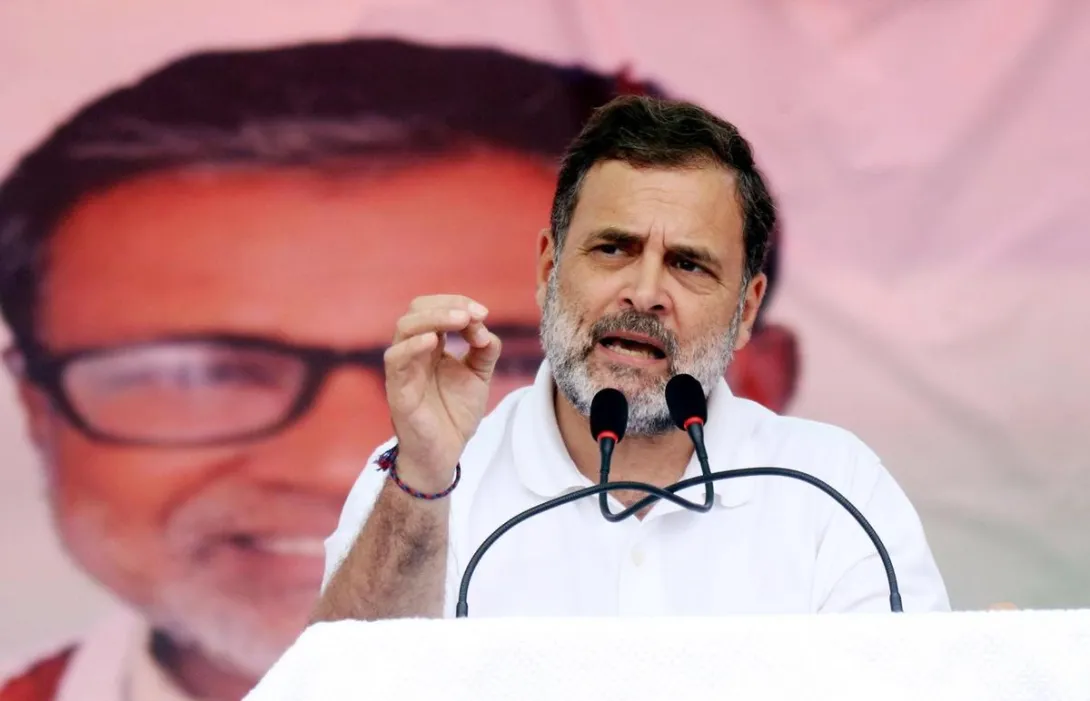
In a sharp political attack, Congress leader Rahul Gandhi has accused Prime Minister Narendra Modi of being “scared” of former U.S. President Donald Trump, alleging that India’s foreign policy under the Modi government has been marked by timidity and misplaced priorities. Speaking at a public gathering, Gandhi criticized the Prime Minister’s approach to global diplomacy, suggesting that India’s leadership has compromised national interests for personal optics. His remarks have ignited another round of political sparring between the ruling Bharatiya Janata Party (BJP) and the opposition, highlighting growing tensions over India’s international image and strategic posture.
---
Political Tensions Resurface
Rahul Gandhi’s latest remarks have added fuel to India’s already charged political landscape. During his address, the Congress leader asserted that Prime Minister Modi’s interactions with former U.S. President Donald Trump reflected a lack of confidence and independence in India’s foreign policy. “Modi is scared of Trump,” Gandhi reportedly said, emphasizing what he described as the Prime Minister’s “insecurity” on the global stage.
The statement, though politically charged, touches upon broader questions about India’s diplomatic assertiveness, especially in its engagement with major world powers. Gandhi’s criticism suggests that the Congress party views the Modi government’s foreign policy as personality-driven rather than institutionally grounded.
---
Congress’ Broader Critique of Foreign Policy
Rahul Gandhi’s accusation aligns with the Congress party’s recurring criticism that the government has over-personalized India’s international relations. According to him, strong nations are defined not by individual leaders’ equations but by stable, long-term diplomatic frameworks rooted in national interest.
He pointed out that India’s image abroad should not be based on photo opportunities or joint rallies but on mutual respect and equality in dialogue. Gandhi contended that a leader’s strength is demonstrated not by their proximity to global powers but by their ability to defend the country’s sovereignty and independent voice.
---
BJP’s Response: “Baseless and Political”
The Bharatiya Janata Party swiftly responded to Gandhi’s remarks, calling them “unfounded and politically motivated.” Senior party leaders argued that Prime Minister Modi’s global outreach has elevated India’s international standing, fostering stronger ties with major powers, including the United States.
A BJP spokesperson countered that Modi’s rapport with global leaders like Trump was a reflection of India’s growing influence, not subservience. “Under Prime Minister Modi, India has moved from being a hesitant nation to a confident voice on the world stage,” the spokesperson stated, dismissing Gandhi’s comments as an attempt to undermine India’s diplomatic achievements for electoral gain.
---
India-U.S. Relations Under Scrutiny
The exchange between Gandhi and the BJP underscores the persistent domestic debate over India’s foreign policy trajectory. Under Modi, India’s relationship with the U.S. has witnessed several high-profile moments—from the “Howdy, Modi!” event in Houston to defense and trade discussions strengthening bilateral cooperation.
Critics, however, argue that such events often blur the line between diplomacy and political spectacle. They contend that excessive personalization of international relations can expose India to vulnerabilities, especially during leadership transitions abroad. Gandhi’s remarks thus revive the broader discourse on whether India’s diplomacy should prioritize continuity and institutional depth over headline-driven engagement.
---
A Clash of Political Philosophies
At the heart of this controversy lies a deeper ideological contrast. The Congress party has traditionally favored a multi-aligned foreign policy, emphasizing balance and strategic autonomy, while the BJP’s approach under Modi has leaned toward assertive nationalism and strong bilateral partnerships.
Gandhi’s charge that Modi is “scared” of Trump symbolically critiques this shift—suggesting that the Prime Minister’s outward confidence masks a dependency on external validation. Meanwhile, the ruling party views such accusations as dismissive of India’s evolving geopolitical stature, arguing that Modi’s leadership has given India a decisive and respected role on the global stage.
---
Public Reaction and Political Implications
Gandhi’s remarks have predictably polarized opinion. Supporters of the Congress leader argue that he has raised legitimate concerns about transparency and over-centralization in foreign policymaking. BJP supporters, on the other hand, see the comments as an attempt to undermine national pride and question India’s diplomatic credibility.
With elections looming, such exchanges are likely to intensify. Analysts suggest that Gandhi’s rhetoric aims to energize opposition narratives around accountability, governance, and India’s global image—areas where the Congress party believes the ruling government is vulnerable.
---
Conclusion
Rahul Gandhi’s claim that Prime Minister Modi is “scared of Trump” encapsulates more than just a political barb—it reflects an ongoing ideological clash over how India defines its strength and sovereignty in global affairs. While the BJP defends Modi’s diplomacy as bold and transformative, the Congress frames it as superficial and personality-driven.
As India continues to navigate an increasingly complex world order, the debate between symbolism and substance in foreign policy will likely persist, shaping not only the country’s diplomatic strategies but also its domestic political narrative.
Comments