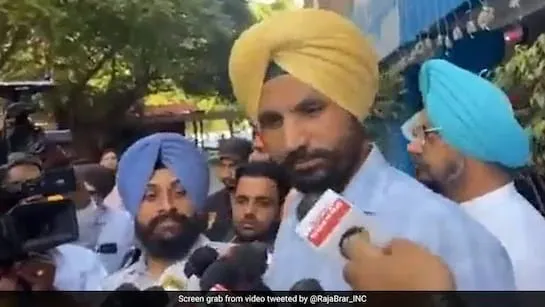
Punjab Congress President Amarinder Singh Raja Warring has been booked for allegedly making casteist remarks during a recent public event, sparking widespread political debate and legal scrutiny. The case, registered under provisions of the Scheduled Castes and Scheduled Tribes (Prevention of Atrocities) Act, has drawn sharp reactions from across the political spectrum. Warring, a prominent figure in Punjab’s political landscape, has denied any intent to offend, calling the complaint a politically motivated move. The controversy arrives at a crucial juncture, with the state’s political climate already charged ahead of upcoming elections, intensifying the confrontation between rival parties.
---
The Allegations and Legal Proceedings
The complaint against Raja Warring was lodged following remarks he allegedly made that were deemed derogatory toward members of a Scheduled Caste community. Based on the complaint, authorities filed a case under relevant sections of the Scheduled Castes and Scheduled Tribes (Prevention of Atrocities) Act, a stringent law designed to prevent discrimination and protect the dignity of marginalized groups.
According to officials, the remarks were made during a public address in Punjab, where Warring was speaking on local governance and political accountability. Soon after the speech, social organizations and community leaders condemned the comments, demanding legal action and a public apology.
The registration of the case has triggered a formal investigation. Law enforcement agencies are currently reviewing video evidence and statements to ascertain context and intent—two crucial factors in cases of alleged hate speech.
---
Raja Warring’s Response
In a swift rebuttal, Raja Warring dismissed the allegations as baseless and politically motivated. He stated that his comments were taken out of context and did not target any community or individual. Emphasizing his commitment to social harmony, Warring expressed respect for all sections of society and claimed that the controversy was being fueled by opponents seeking to damage his reputation ahead of elections.
The Punjab Congress unit has rallied behind its chief, calling the case an act of political vendetta orchestrated to tarnish the party’s image. Party spokespersons have demanded a fair and transparent inquiry, asserting that the BJP and AAP are attempting to exploit identity politics to divert public attention from governance issues.
---
Political Reactions Across the Spectrum
The incident has intensified political fault lines in Punjab. Rival parties have seized the opportunity to criticize the Congress, arguing that Warring’s remarks reflect the party’s disconnect from the state’s social realities. Leaders from Dalit organizations have condemned the statement, urging authorities to pursue the case without bias.
The Aam Aadmi Party (AAP), currently in power in Punjab, has called for accountability, while the Bharatiya Janata Party (BJP) has accused Congress of hypocrisy—claiming that despite its public rhetoric of social justice, its leaders continue to engage in divisive politics.
Meanwhile, community groups and civil society organizations are closely monitoring the developments, stressing the need to address the broader issue of caste-based insensitivity in public discourse.
---
Legal Context and Broader Implications
The case against Warring brings renewed attention to the SC/ST (Prevention of Atrocities) Act, one of India’s most critical legal safeguards against caste-based discrimination. Under the Act, any derogatory statement or action that insults or intimidates a member of a Scheduled Caste or Scheduled Tribe is considered a serious offense, often non-bailable and subject to strict penalties.
Legal experts note that cases involving political figures often hinge on the interpretation of “intent.” If the alleged remarks are proven to have been made without malice or were misrepresented, Warring could be cleared. However, if intent is established, the matter could have serious repercussions for his political career and public standing.
---
Impact on Punjab’s Political Landscape
The controversy arrives at a politically sensitive time for Punjab, with multiple parties vying for influence in the lead-up to local and national elections. Warring, known for his outspoken style and populist appeal, has been central to the Congress’s efforts to regain lost ground in the state.
Analysts believe the case could serve as both a political challenge and an opportunity. While it may temporarily damage Warring’s credibility, it also allows him to project himself as a victim of political targeting—a narrative that could resonate with his supporters.
The outcome of the investigation will likely influence not only Warring’s political future but also the broader discourse on caste, accountability, and leadership ethics in Punjab’s evolving political arena.
---
Conclusion
The charges against Raja Warring mark yet another flashpoint in Punjab’s increasingly polarized political climate. As the investigation unfolds, the case serves as a reminder of the delicate balance between free speech, social responsibility, and political accountability. Whether this controversy diminishes Warring’s influence or strengthens his resolve will depend on the legal findings—and how the narrative unfolds in the court of public opinion.
Comments