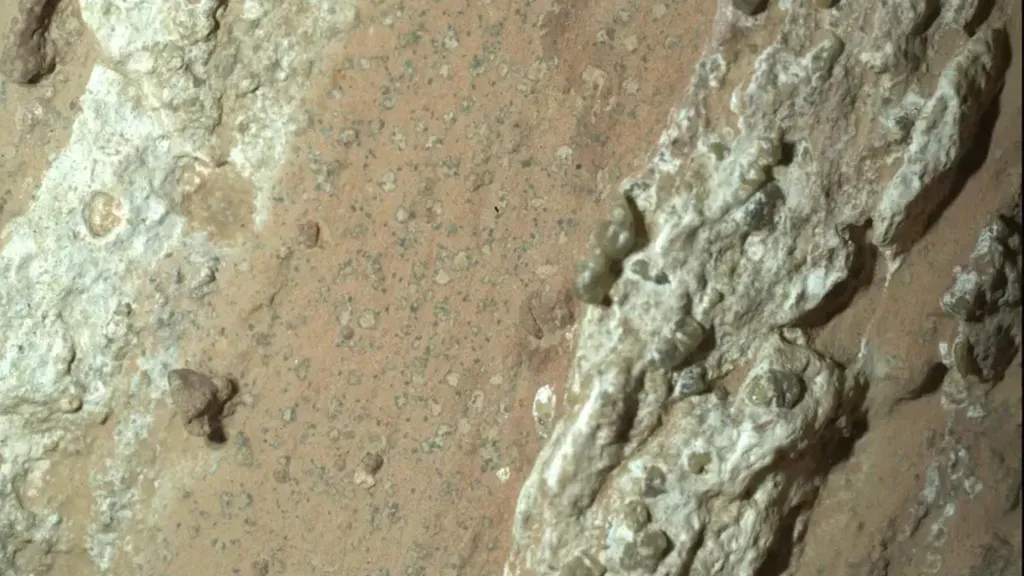
NASA’s Perseverance rover has made an intriguing discovery on the Martian surface, triggering its metal detector and revealing a shiny, unidentified object that may provide insights into the planet’s geological and potentially biological history. This find represents a significant milestone in the ongoing search for signs of past life on Mars, complementing the rover’s suite of advanced instruments designed for planetary analysis. By examining mineral composition, chemical signatures, and surface morphology, scientists hope to understand whether these materials were formed through natural processes or influenced by conditions favorable to microbial life, marking a crucial step in interplanetary exploration.
A Shiny Discovery on the Red Planet
Perseverance’s metal detector recently signaled the presence of a reflective material on Mars, prompting closer examination. While the exact composition remains under study, initial observations suggest unusual mineral content that stands out against the surrounding regolith. Such discoveries provide researchers with tangible clues about the planet’s surface chemistry and history, helping reconstruct environmental conditions that prevailed millions of years ago.
Implications for Astrobiology
The find could have profound implications for the search for extraterrestrial life. Shiny or metallic formations may indicate mineral deposits formed in water-rich environments or through chemical processes that could sustain microbial life. By studying these formations, scientists aim to determine whether Mars ever hosted conditions conducive to life, refining our understanding of planetary habitability.
Technological Precision in Exploration
The detection highlights the advanced capabilities of Perseverance’s instruments, which include spectrometers, cameras, and environmental sensors. These tools allow for in-depth analysis of surface materials, identifying chemical elements and mineralogical structures that can reveal Mars’ geologic history. The integration of robotic exploration and precise instrumentation is pivotal in pushing the boundaries of planetary science.
Next Steps in the Investigation
Following the metal detector alert, the rover team plans to conduct a series of analyses, including high-resolution imaging, spectroscopy, and sampling. These studies will help determine the object’s composition and origin, offering potential clues about Mars’ past environmental conditions and the ongoing quest to identify signs of ancient microbial life. Each discovery like this brings humanity closer to answering the profound question of whether we are alone in the universe.
Comments