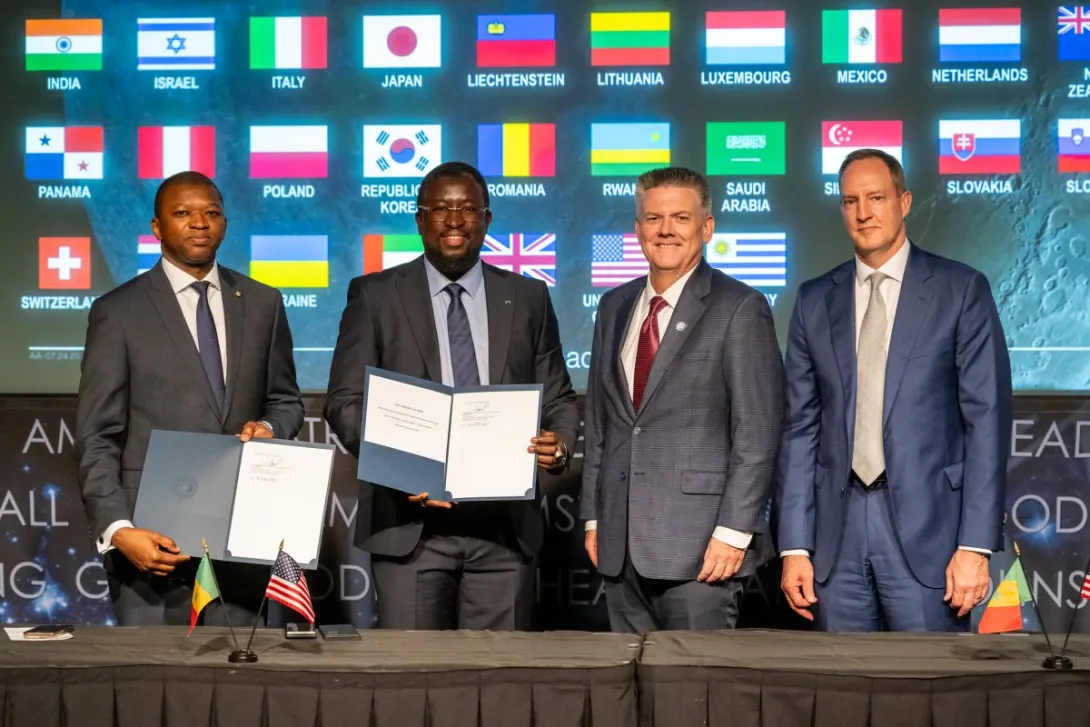
Senegal has officially become the latest nation to join the Artemis Accords—an international framework aimed at promoting peaceful, transparent, and cooperative exploration of space. Spearheaded by NASA and backed by over 30 countries, the Artemis Accords outline principles to govern civil space activity, including the sustainable use of lunar resources and shared scientific data. Senegal’s endorsement not only signals its commitment to ethical space engagement but also reinforces Africa’s growing presence in the global aerospace dialogue. As space diplomacy intensifies, Senegal’s inclusion adds a new dimension to the increasingly multilateral governance of outer space.
A New Era of Space Diplomacy
The Artemis Accords, introduced in 2020 by NASA in partnership with the U.S. Department of State, have quickly evolved into a cornerstone of international cooperation in space. Developed alongside the Artemis lunar missions, the Accords are a non-binding multilateral agreement outlining best practices for spacefaring nations—emphasizing transparency, interoperability, and peaceful exploration.
With Senegal's formal entry, the number of signatories grows, signaling broader geographic and geopolitical support for a cooperative space governance framework. This addition also showcases Africa’s accelerating role in scientific diplomacy and space policy.
Why Senegal’s Participation Matters
Senegal’s decision to join the Artemis Accords carries both symbolic and strategic weight. As a member of the African Union and an emerging player in the region's science and technology sectors, Senegal’s endorsement represents a broader continental interest in shaping global space norms. It reflects the country’s intent to engage in the international space economy, develop research capabilities, and influence policies governing the final frontier.
Moreover, Senegal’s participation may catalyze further engagement from African nations, many of which are in the process of building domestic space programs focused on telecommunications, Earth observation, and climate research.
Shared Principles for a Sustainable Future in Space
The Artemis Accords are grounded in principles derived from the 1967 Outer Space Treaty, the foundational legal document governing outer space activities. However, the Accords go further by addressing contemporary challenges such as space debris mitigation, resource sharing, emergency assistance, and open access to scientific data.
Senegal’s alignment with these ideals affirms its support for responsible behavior in space. The country has now joined a growing list of nations that aim to avoid the weaponization of space and ensure that exploration and resource utilization on the Moon and beyond are conducted transparently and for the benefit of all humanity.
Expanding the Global Governance Framework
The inclusion of new signatories like Senegal illustrates how space exploration is no longer the domain of a few technologically advanced countries. Instead, it is increasingly multilateral, inclusive, and collaborative. The Artemis Accords serve as a platform not just for exploration, but also for dialogue—uniting nations across different development levels in shaping how humanity approaches space as a shared domain.
As geopolitical tensions grow in low-Earth orbit and beyond, cooperative frameworks like the Artemis Accords provide a counterbalance—an alternative rooted in scientific exchange, peaceful intent, and mutual accountability.
Final Thoughts: A Future Shared Among Nations
Senegal’s entry into the Artemis Accords is a reminder that the future of space belongs to no single nation or bloc. It belongs to all who are willing to commit to exploration with transparency, mutual respect, and scientific integrity. As the global community prepares for manned lunar missions and lays the groundwork for Mars expeditions, frameworks like these ensure that the journey ahead remains inclusive, responsible, and guided by shared values.
By joining the Accords, Senegal has staked a claim not only in space governance but also in the vision of a collaborative interplanetary future—where science, sovereignty, and diplomacy intersect at the edge of human possibility.
Comments