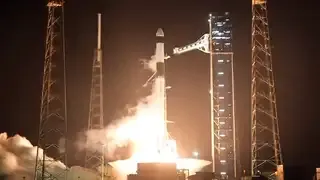
The Crew-12 mission lifted off successfully from Cape Canaveral Space Force Station, reinforcing the operational maturity of NASA’s commercial spaceflight partnerships. The launch, conducted aboard a SpaceX Falcon 9 rocket, carries astronauts on a long-duration mission to the International Space Station. The mission underscores the reliability of reusable launch systems and the expanding role of private-sector collaboration in space exploration. Analysts view the event as another validation of the commercial crew model, which has reduced launch costs while enhancing mission frequency. The successful liftoff highlights continued progress in human spaceflight and international scientific cooperation.
Liftoff from Cape Canaveral
The Crew-12 mission launched from Cape Canaveral Space Force Station, a historic site synonymous with American space exploration. The spacecraft ascended atop a Falcon 9 rocket developed by SpaceX in partnership with NASA.
Weather conditions were favorable at launch, enabling a smooth countdown and ignition sequence. Within minutes, the rocket achieved orbit, marking another precisely executed operation in the commercial crew program.
Mission Objectives and ISS Operations
Crew-12 is bound for the International Space Station, where astronauts will undertake scientific research, technology demonstrations and routine maintenance.
Long-duration missions aboard the ISS contribute to biomedical studies, materials research and climate observation. The station continues to serve as a laboratory in microgravity, advancing knowledge that supports both terrestrial innovation and future deep-space missions.
NASA officials emphasized that sustained crew rotation ensures operational continuity aboard the orbiting outpost.
The Commercial Crew Model
The Crew-12 launch reflects the maturation of NASA’s commercial crew framework. By outsourcing spacecraft development and launch services to private companies, NASA has shifted from sole operator to strategic partner.
This model has delivered measurable efficiencies. Reusable rocket technology has significantly reduced per-launch costs, while increased cadence has strengthened logistical reliability.
SpaceX’s Falcon 9 booster, designed for recovery and refurbishment, has become emblematic of this cost-conscious engineering philosophy.
Economic and Strategic Significance
Human spaceflight now operates at the intersection of science, commerce and geopolitics. The commercial crew initiative has stimulated private investment in aerospace manufacturing and supply chains, supporting high-skilled employment.
Analysts note that sustained launch activity reinforces U.S. leadership in orbital transportation services. Moreover, dependable crew rotation strengthens international collaboration, as astronauts from multiple countries participate in ISS missions.
Risk Management and Technological Reliability
Each crewed launch undergoes extensive safety verification. The reliability record of recent missions has bolstered confidence among policymakers and industry stakeholders.
The Falcon 9 system’s reusability not only enhances economic viability but also demonstrates engineering resilience—an essential attribute for long-term exploration goals, including lunar and Mars missions.
Conclusion
The successful liftoff of Crew-12 from Cape Canaveral marks another chapter in the evolution of commercial spaceflight. The mission underscores the effectiveness of public-private collaboration, technological innovation and disciplined operational execution.
As the global space economy expands, missions such as Crew-12 exemplify how strategic partnerships can deliver both scientific advancement and sustainable commercial growth beyond Earth’s atmosphere.
Comments