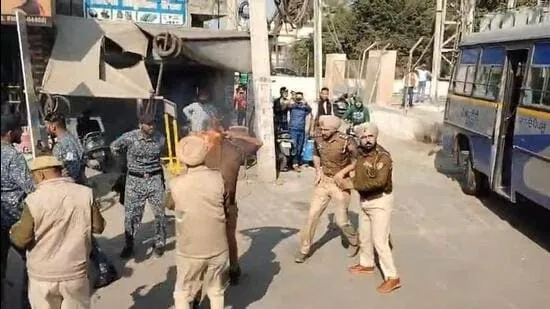
A protest by Punjab Roadways and PRTC employees spiraled into violence, leaving a senior police officer injured during a confrontation in Dhuri. What began as a demonstration over longstanding demands turned chaotic when tensions rose between agitators and law enforcement. The incident, which resulted in burn injuries to the station house officer (SHO), has intensified scrutiny of the state’s handling of transport-sector grievances. The unrest underscores the widening discord between employees and the administration, fueling calls for urgent dialogue, policy clarity, and improved workplace conditions. As investigations unfold, the episode marks one of the most serious escalations in the ongoing transport workers’ movement.
Growing Tensions in Punjab’s Transport Sector
The continuing dispute between Punjab Roadways and PRTC employees and the state government has reached a breaking point. Workers have been pushing for the fulfilment of several unresolved demands, including improved job security, timely recruitment, and the revival of fleet operations. Their demonstrations, which have been ongoing for weeks, reflect a deepening frustration over what employees describe as systemic neglect and unaddressed operational challenges.
Protest Turns Violent in Dhuri
The situation escalated sharply in Dhuri when a confrontation erupted between the agitators and police officials deployed to maintain order. According to preliminary information, protestors blocked key routes and attempted to intensify their agitation, prompting a heavy police response. Amid the clash, the Dhuri SHO suffered burn injuries when a flammable substance—reportedly part of the protest materials—ignited during the scuffle.
The injured officer was immediately rushed for medical treatment, and police reinforcements were called to restore control. The event has drawn concern from senior officials, who have instructed authorities to review the circumstances that allowed the agitation to turn volatile.
Workers’ Standpoint and Core Demands
Employees allege that the transport infrastructure has deteriorated over the years due to insufficient investment and policy delays. Their demands include regularisation of contract workers, recruitment of technical staff, and the expansion of the bus fleet to ensure financial sustainability. Many employees argue that their protests are a last resort after months of limited governmental response.
Union representatives maintain that their movement is rooted in protecting public transport services, which they claim are essential to rural and low-income communities. They insist that meaningful negotiations could prevent further disruptions.
Government’s Response and the Road Ahead
The violent turn has placed additional pressure on the state to address the crisis swiftly. Officials have indicated that discussions with union leaders may resume, emphasizing the need to maintain law-and-order while acknowledging the workers’ concerns.
The incident raises broader questions about public-sector workforce management, especially in essential services where operational lapses have direct economic and social consequences. Analysts note that a balanced approach—combining administrative reforms with workforce engagement—will be critical in de-escalating tensions and preventing similar episodes.
A Call for Dialogue and Structural Reform
As the state faces the aftermath of the Dhuri violence, the episode serves as a reminder of the fragile relationship between public institutions and their frontline staff. Sustainable resolution will require more than temporary intervention; it demands structural reforms, transparent communication, and an updated roadmap for the transport sector’s modernization.
The coming days will reveal whether the government and employee unions can find common ground to prevent further unrest and ensure uninterrupted transport services across Punjab.
Comments