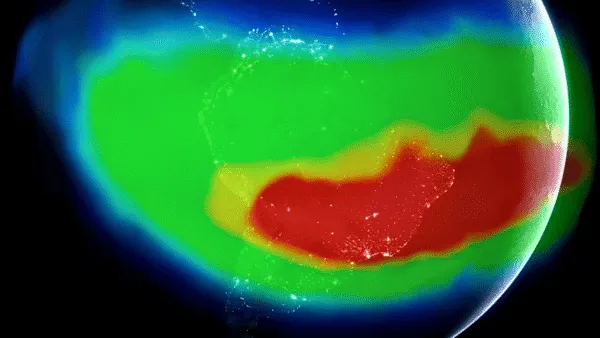
NASA is closely observing a rapidly evolving irregularity in Earth’s magnetic field, a region known for its unusually weak magnetic strength. This anomaly, expanding gradually over the South Atlantic and parts of the southern hemisphere, has drawn significant scientific interest due to its potential impact on satellites, spacecraft instrumentation, and atmospheric behavior. As the magnetic field serves as a protective shield against solar radiation, any structural weakness poses operational challenges for space agencies and research institutions worldwide. NASA’s continuous monitoring of this anomaly reflects its broader mission to understand planetary dynamics, geomagnetic shifts, and their long-term implications for technology and global infrastructure.
Understanding the South Atlantic Magnetic Anomaly
The anomaly currently under NASA’s detailed scrutiny—commonly referred to as the South Atlantic magnetic anomaly—represents a region where Earth’s magnetic field is considerably weaker than its global average. This weakening reduces the planet’s natural protection against charged solar particles, creating a zone of elevated radiation exposure.
For decades, scientists have observed the anomaly’s slow but steady growth. Its shifting boundaries and decreasing field strength signal complex geophysical processes occurring deep within Earth’s core, where the magnetic field is generated through the movement of molten iron.
Why NASA Is Intensifying Surveillance
NASA’s interest in the magnetic anomaly is rooted in operational necessity. The weakened field poses tangible risks to satellites and spacecraft that traverse the region. Sensitive onboard systems, including sensors, memory units, and communication devices, can be disrupted by increased radiation levels.
To counter these challenges, mission engineers often program satellites to power down non-essential systems when crossing the anomaly. NASA’s advanced monitoring tools help predict fluctuations in magnetic intensity, thereby improving spacecraft resilience and minimizing risk.
Potential Risks for Satellites and Space Technology
The anomaly’s growth has become a matter of strategic concern across the global space industry. Elevated radiation can:
- Interrupt satellite operations, leading to temporary data corruption or system resets.
- Accelerate material degradation, especially among long-lived satellites.
- Increase mission costs, as spacecraft require more robust shielding and fail-safe mechanisms.
For commercial operators, these risks translate into higher insurance premiums, more frequent technical interventions, and increased expenditure on spacecraft hardening—factors that ultimately influence market pricing and investment patterns across the satellite economy.
Scientific Insights Into Earth’s Magnetic Evolution
Geomagnetic variations are not new; Earth’s magnetic field undergoes natural shifts, including periodic polarity reversals. However, the current anomaly’s scale has prompted renewed focus on how Earth’s inner core behaves. Scientists believe the anomaly may be linked to changes in internal fluid dynamics beneath the African continent, where patches of weakened magnetic influence appear to rise closer to the surface.
These findings broaden scientific understanding of planetary physics, contributing to improved predictive models used in climate science, atmospheric studies, and deep-Earth research.
Global Implications Beyond Space Exploration
Although the anomaly poses no immediate risk to human life on Earth, its impact on global infrastructure is becoming increasingly relevant. As economies depend more heavily on satellite-supported systems—such as navigation services, communication networks, climate monitoring, and defense technologies—the resilience of space assets becomes a cornerstone of economic and national security planning.
Government agencies and private firms are beginning to incorporate magnetic field variability into long-term strategic assessments, particularly as satellite constellations expand and demand for uninterrupted connectivity increases.
Looking Ahead: Monitoring a Dynamic Planet
NASA’s sustained focus on the magnetic anomaly underscores a fundamental reality: Earth is an ever-changing system, shaped by forces far beneath its surface. Continued research will enable scientists to refine models of magnetic field behavior, improve spacecraft protection strategies, and strengthen global technology infrastructure.
As the anomaly evolves, its study will remain central to understanding how planetary physics intersects with modern economic and technological dependencies—an intersection that will shape scientific investment and innovation for years to come.
Comments