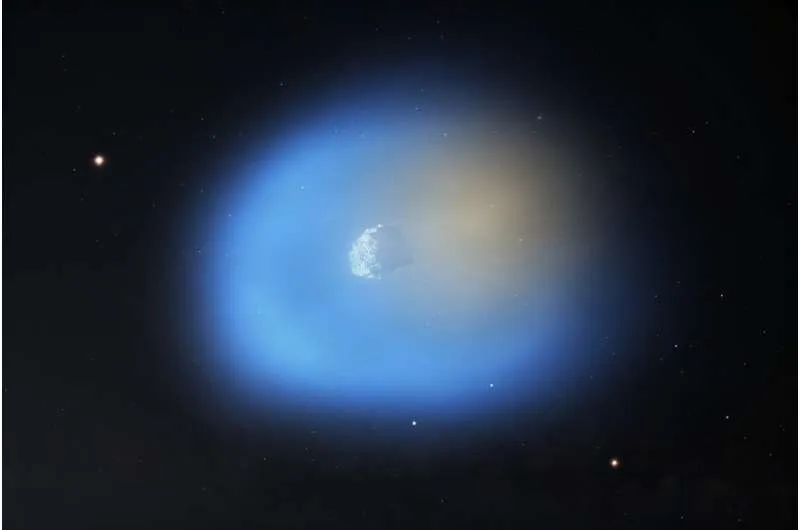
Astronomers have turned to one of the world’s most advanced radio observatories to study comet 3I/ATLAS, aiming to better understand the composition and behavior of this distant celestial object. By using highly sensitive instruments, researchers hope to analyze the gases, dust, and molecular structures surrounding the comet. Such studies provide valuable insights into the early formation of the solar system and the materials that existed during its infancy. Observations conducted with powerful telescopes can reveal chemical signatures that are otherwise invisible to optical instruments. The findings may help scientists refine models explaining how comets evolve as they travel through space.
Advanced Telescope Technology Targets Comet 3I/ATLAS
Astronomers have used the powerful capabilities of the Atacama Large Millimeter/submillimeter Array—commonly known as ALMA—to observe and analyze the distant celestial object Comet 3I/ATLAS. Located in the high-altitude deserts of Chile, ALMA is among the most sophisticated radio observatories in the world, designed to capture faint signals from deep space.
By focusing its network of antennas on the comet, researchers aim to detect subtle emissions from gas and dust particles released as the object travels through the solar system. These observations enable scientists to examine the chemical composition of the comet’s surrounding atmosphere, also known as its coma.
Such research can offer critical clues about the origins and evolution of objects that traverse the outer regions of planetary systems.
Understanding the Composition of Interstellar Visitors
Comets like 3I/ATLAS are of particular interest to astronomers because they often carry primordial materials that date back billions of years. These icy bodies can act as cosmic time capsules, preserving chemical elements that were present during the earliest stages of planetary formation.
By analyzing the radio-frequency signals detected by ALMA, scientists can identify specific molecules—such as water vapor, carbon monoxide, and complex organic compounds—that are released from the comet’s nucleus as it warms while approaching the Sun.
Understanding these chemical signatures helps researchers build more accurate models of how planetary systems evolve and how essential ingredients for life may have been distributed across the cosmos.
ALMA’s Role in Modern Astronomy
The Atacama Large Millimeter/submillimeter Array represents one of the most ambitious collaborative projects in modern astronomy. Operated through international cooperation among scientific institutions across several continents, ALMA consists of dozens of high-precision antennas that work together to capture radio waves emitted by distant cosmic objects.
Unlike optical telescopes that rely on visible light, ALMA observes the universe at millimeter and submillimeter wavelengths. This capability allows scientists to detect cold gases and dust that are invisible to conventional instruments.
For studying comets and other small bodies in the solar system, this technology is particularly valuable because it reveals the molecular structure of materials that would otherwise remain hidden.
Insights Into the Early Solar System
Comet research has long played a crucial role in helping scientists understand the origins of our planetary neighborhood. Many researchers believe that comets contain some of the oldest material in the solar system, offering direct evidence of the conditions that existed when planets were forming.
By examining the chemical composition of objects like 3I/ATLAS, astronomers can compare them with other known comets and determine whether they formed within our solar system or originated in distant star systems.
Such discoveries not only expand scientific knowledge but also help refine theories about how cosmic material travels between different regions of the galaxy.
The Broader Significance of Comet Studies
Research involving advanced observatories like ALMA contributes to a deeper understanding of the universe’s fundamental processes. Observations of comets provide insights into the distribution of organic compounds and volatile materials that may influence the development of planetary environments.
For the global scientific community, studying rare objects such as 3I/ATLAS represents an opportunity to gather data that could reshape existing models of cosmic evolution.
The findings also highlight how international collaboration and cutting-edge technology continue to push the boundaries of astronomical research.
Looking Ahead
As observations continue, astronomers expect the data gathered by ALMA to reveal more detailed information about comet 3I/ATLAS and its physical characteristics. Future studies may uncover additional molecular signatures that shed light on the comet’s origin and trajectory through space.
In the broader context of space science, each new comet study adds another piece to the puzzle of how planetary systems—and potentially life-supporting environments—develop across the universe.
Through the use of powerful observatories and advanced analytical techniques, researchers are steadily unlocking the secrets carried by these ancient travelers of the cosmos.
Comments