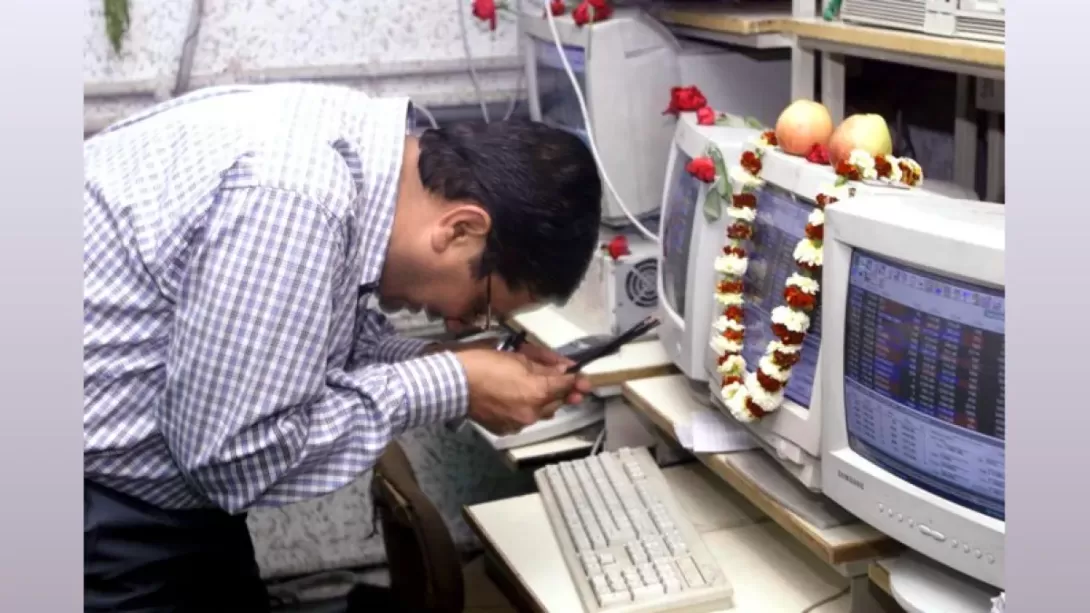
Indian equity benchmarks Sensex and Nifty slumped in early trading Thursday, mirroring the global selloff triggered by renewed concerns over the United States’ fiscal health and rising Treasury yields. The BSE Sensex shed over 746 points intraday, while the Nifty dropped more than 230 points, reflecting heightened investor anxiety. Weakness in heavyweight stocks such as Power Grid, TCS, and HCL Technologies contributed significantly to the decline. Meanwhile, Asian markets offered little support, with most major indices trending lower. Despite foreign institutional investors (FIIs) returning as net buyers, broader market sentiment remained fragile amid fears of an overheated U.S. bond market and resurgent COVID-19 concerns.
Indian Markets Take a Hit Amid Global Risk-Off Sentiment
Benchmark indices in India opened Thursday’s session on a sharply negative note, tracking losses in global equities. The BSE Sensex plunged 578.3 points to 81,018.33 in the initial trades and extended its losses further to 746.48 points, reaching 80,832.82 later in the session. The NSE Nifty mirrored the downturn, falling by 203.45 points to 24,610 at open and slipping as much as 233.80 points to trade at 24,575.65.
Leading the decline were blue-chip stocks such as Power Grid, Tech Mahindra, HCL Technologies, Nestle India, Hindustan Unilever, ITC, Tata Consultancy Services, and Mahindra & Mahindra. On the other hand, Adani Ports and IndusInd Bank stood out as rare gainers in an otherwise gloomy market.
Global Markets Rattle Under U.S. Debt Pressure
The market rout in India echoed a broader trend across global equity markets. Asian indices were mostly lower, with South Korea’s Kospi, Japan’s Nikkei 225, and Hong Kong’s Hang Seng all registering losses. Only China’s Shanghai Composite Index remained marginally in positive territory, offering scant relief.
In the U.S., major indices closed significantly lower on Wednesday. Investor confidence was shaken by a weak 20-year U.S. Treasury bond auction and surging yields across 5-year, 10-year, and 30-year bonds. Analysts interpret these developments as signals of declining investor faith in the sustainability of U.S. fiscal policy.
VK Vijayakumar, Chief Investment Strategist at Geojit Financial Services, warned that the “root cause of the current market unease is the unsustainable U.S. fiscal deficit and mounting national debt,” which have prompted investors to reassess their appetite for risk, particularly in emerging markets.
Rising U.S. Yields Threaten Emerging Market Stability
Typically, higher yields on U.S. government bonds dampen foreign capital flows to emerging markets by making American debt instruments more attractive. However, Vijayakumar noted that the current situation is nuanced, as the underlying issue is not just yield dynamics but a deeper concern over fiscal irresponsibility in the world's largest economy.
Global oil prices remained relatively steady despite the turbulence. Brent crude futures edged down marginally by 0.05 percent to USD 64.88 per barrel, indicating that commodities are not yet fully reacting to the broader macroeconomic instability.
Technical Headwinds and Market Sentiment
Despite a brief rally on Wednesday, when the Sensex rose 410.19 points and the Nifty added 129.55 points, Thursday’s selloff demonstrated the fragility of market confidence. Prashanth Tapse, Senior Vice President of Research at Mehta Equities Ltd, observed that while technical indicators had suggested a rebound, overbought levels combined with global macro concerns led to the swift return of bearish sentiment.
He added that rising COVID-19 cases globally are adding another layer of caution, compounding the anxiety stemming from fiscal and monetary dynamics in developed economies.
Foreign Investors Remain a Mixed Influence
Interestingly, Foreign Institutional Investors (FIIs) reversed course on Wednesday and turned net buyers, purchasing equities worth Rs. 2,201.79 crore. This inflow came after a brief hiatus and signals that some investors may still view Indian equities as relatively attractive amid the global uncertainty. Nevertheless, continued volatility in global bond yields could quickly sway foreign fund flows in the near term.
Conclusion
Thursday’s market decline is emblematic of the growing interconnectedness between domestic equity performance and international macroeconomic developments. While India’s long-term fundamentals remain strong, short-term headwinds—especially those originating from U.S. fiscal policies and bond market turmoil—could continue to trigger bouts of volatility. For investors, navigating the coming weeks will require a fine balance between vigilance and patience as markets digest complex global signals.
Comments